Finding a reliable China Computer Table supplier requires more than comparing online prices. Quality, production control, export experience, and communication all matter.
China remains a major global furniture manufacturing hub. The CSIL World Furniture Outlook 2024 identifies China as the world’s largest furniture producer and exporter. Statista Market Insights also reports strong furniture demand across China’s e-commerce and commercial sectors. These findings suggest broad supplier capacity, but they do not guarantee dependable performance. A polished product page proves little.
Look for suppliers with verifiable factory details, stable production records, and clear material specifications. Ask for photographs of cutting, edge-banding, drilling, and packaging processes. A practical factory audit should check dust control, worker safety, moisture protection, and finished-table storage. The China National Furniture Association offers useful industry context, while ISO 9001 certification can indicate documented quality procedures. Still, certification alone is not enough.
Request samples before approving a large order. Measure tabletop thickness, cable-management openings, screw alignment, load capacity, and surface durability. For office projects, confirm carton dimensions and installation instructions. For home use, inspect rounded edges and stability on uneven floors. Trade data from the International Trade Centre can help compare China’s broader furniture-export activity, although computer tables may appear under wider HS categories. That limitation deserves attention.
I would compare at least three suppliers.
Ask each one for the same quotation sheet. Include materials, dimensions, packaging, lead time, warranty, and inspection terms. Many buyers focus on unit cost and overlook replacement parts or port delays. That mistake can become expensive. A trustworthy supplier welcomes detailed questions and provides consistent answers. If responses change repeatedly, keep searching. Supplier selection is not a perfect formula; it requires evidence, testing, and careful judgment.
China’s computer-table suppliers range from specialized desk factories to broader furniture manufacturers and trading companies. Their capabilities differ: one factory may offer adjustable frames, while another focuses on flat-pack desks with laminated tops. The National Bureau of Statistics of China reported that above-designated-size furniture manufacturers generated RMB 655.6 billion in operating revenue in 2023, down 4.4% year over year. This covers the wider furniture industry, not computer tables alone. A large sector does not guarantee consistent quality.
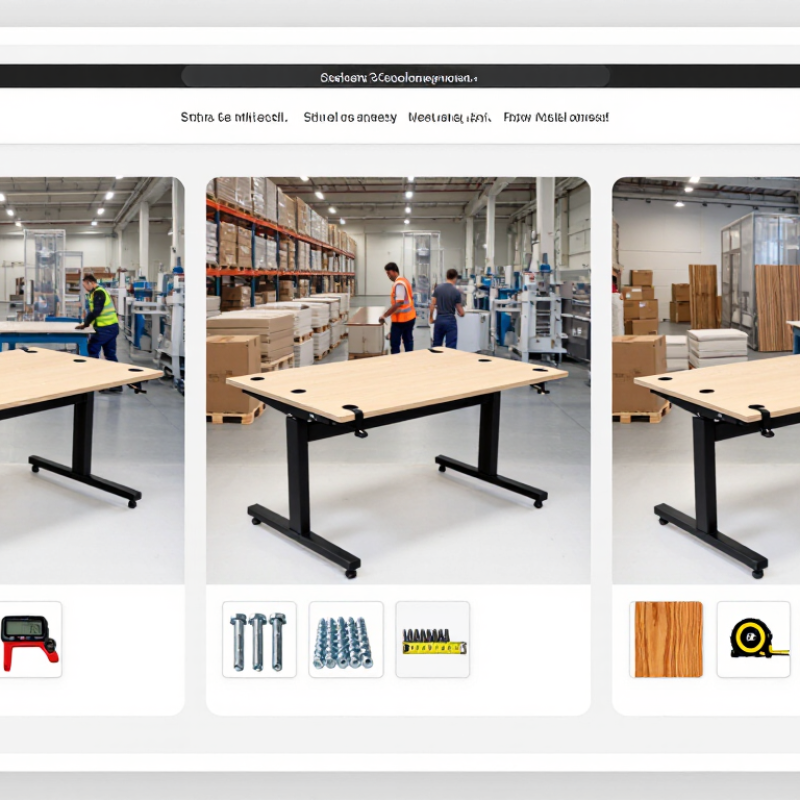
Compare suppliers by production scope, materials, customization, and quality-control records—not catalog size. Ask for close-up photos of edge banding, welds, cable openings, and carton protection. Request a sample and check whether its dimensions match the drawings; small mismatches can complicate assembly. Verify which processes are handled in-house and which are outsourced. Supplier profiles can be incomplete, so confirm details in writing. This takes time, but it reduces guesswork.

How to Find Top China Computer Table Suppliers?
Defining Your Product and Sourcing Requirements
A reliable sourcing process starts with a precise product definition. Decide the table size, desktop material, frame structure, color, and load capacity. A 120-by-60-centimeter table serves a different user than a compact gaming desk. Include cable openings, keyboard trays, height adjustment, and storage details. Add drawings with measurements, edge thickness, and acceptable tolerances. Vague requests often produce inconsistent quotations.
Think beyond the product itself. Set your target order quantity, budget range, packaging method, and delivery window. Ask suppliers for samples, production photos, material specifications, and quality-control procedures. My first specification missed carton strength, and several corners arrived damaged. That mistake changed my sourcing checklist. It also showed why shipping conditions deserve the same attention as design.
Tips: Prepare a one-page requirement sheet. List essential features separately from optional upgrades. Request a sample before confirming bulk production. Compare quotes by matching materials, hardware, packaging, and inspection terms. Ask how defects are recorded and corrected. Keep communication in writing. Small details matter. Yet, do not make the document overly rigid; practical adjustments may reduce cost without harming durability.
Define your product and sourcing requirements before contacting suppliers. The chart below uses a practical RFQ priority scale from 1 to 5, where 5 indicates a requirement that should be clearly specified and verified.
The requirements reflect common computer table procurement criteria, including dimensions, load capacity, materials, adjustability, compliance, packaging, and minimum order quantity. The scores are planning benchmarks rather than company-specific performance data.
Finding suitable computer table suppliers begins with a clear specification, not a broad price request. Share target dimensions, tabletop thickness, edge treatment, frame material, finish, load requirement, and packaging needs. Specific questions matter. Compare each supplier’s answers for detail and consistency. Request recent production photos that show joints, undersides, and packaging, not only polished catalog images.
Order a sample before discussing a large production run. Measure the tabletop, check drilled-hole alignment, and assemble it using the supplied instructions. Does the table wobble on a level floor? Are edges smooth, and do cable openings match the drawing? Record any mismatch and ask how it will be corrected. A sample is useful, but it cannot prove every production unit will match. That limitation is easy to overlook.
Verify the supplier through a live video call or an in-person factory visit when practical. Ask to see the workshop, equipment, quality checks, and current production schedule. Confirm business details through appropriate records, then request references from recent buyers. A third-party inspection can check materials, dimensions, finish, and carton labeling before shipment. Keep specifications, approved samples, tolerances, and delivery dates in written records. I would still avoid assuming that a quick call tells the whole story; production conditions can change between visits.
| Verification Dimension | Evidence to Request | Practical Acceptance Standard | Recommended Verification Method | Suggested Weight |
|---|---|---|---|---|
| Legal business identity | Business license, registered address, legal representative, and unified social credit information | Company name and registration details should be consistent across documents, quotations, contracts, and payment instructions | Check the official Chinese enterprise registration database and compare the result with supplier-provided documents | 15% |
| Product specialization | Product catalog, technical drawings, material specifications, and previous export product categories | Demonstrated experience with computer desks, office furniture, or closely related metal and wood products | Review product photos, drawings, production videos, and samples; confirm that specifications match the quotation | 15% |
| Factory capability | Factory address, production-line photos, equipment list, workforce information, and monthly capacity | Capacity should be sufficient for the expected order volume without relying entirely on undisclosed subcontractors | Arrange a live video tour or an independent factory audit; verify equipment and production flow | 15% |
| Material and construction quality | Material grade, board thickness, steel thickness, surface treatment, load rating, and hardware specifications | All critical specifications must be written into the approved sample and purchase contract | Conduct sample inspection, dimensional checks, load testing, weld inspection, edge inspection, and packaging review | 20% |
| Quality management | Quality-control procedures, inspection records, corrective-action process, and applicable management certificates | Supplier can explain incoming-material, in-process, final, and pre-shipment inspection procedures | Request sample inspection reports and use a third-party pre-shipment inspection before final payment | 15% |
| Customization and engineering | Drawing revision process, tooling capability, prototype procedure, and packaging-design support | Supplier can provide a controlled prototype process and confirm tolerances, finishes, cable management, and accessories | Send a written specification sheet and evaluate the first sample against every required feature | 10% |
| Export and compliance readiness | Commercial invoice, packing list, export experience, product test reports, and destination-market requirements | Supplier understands the destination country’s labeling, packaging, safety, and import documentation requirements | Ask for redacted shipping documents and confirm requirements with the importer, customs broker, or testing laboratory | 10% |
| Commercial reliability | Formal quotation, payment terms, production lead time, warranty policy, and reference order information | Terms are clear, consistent, and aligned with the verified legal entity; no unexplained changes in beneficiary or bank account | Use a written contract, verify bank details independently, and begin with a controlled trial order | 10% |
| Total Evaluation Weight | 100% | |||
When comparing China computer table suppliers, inspect the same sample details across every quotation: board thickness, edge sealing, frame gauge, weld finish, and load-test results. Ask for test records tied to the proposed materials, not just a general quality certificate. A tabletop that looks smooth under showroom lighting may reveal chipped edges or uneven laminate under close inspection. This is easy to miss.
Compare the full cost
Price needs context. Compare unit cost alongside tooling, packaging, spare parts, payment terms, and shipping assumptions. China’s National Bureau of Statistics reported RMB 655.7 billion in 2023 operating revenue for furniture manufacturers above its designated size, down 4.4% year on year. That industry-wide figure signals a substantial manufacturing base, but it cannot verify any individual factory’s quality or price.
Request a dated quotation and a breakdown of what changes when materials or order quantities change.
Verify production capability
Production capability is more than a claimed monthly output. Check line capacity, current workload, sample-to-bulk consistency, and how the supplier handles peak-season delays. Request recent production photos or a live video walkthrough, then compare them with a pre-production sample.
A useful caution: even a tidy factory tour may not reveal subcontracting. Ask who makes the tabletop, frame, and packaging, and confirm the approved process in writing.
Still to be tested: bulk consistency.
When searching for top China computer table suppliers, evaluate samples as production evidence, not showroom decoration. Request a full-size sample with the intended board, frame, cable grommet, and packaging. Measure height, load capacity, edge alignment, and surface defects under direct light. Photograph every detail. A small wobble can become a costly batch problem. I would also ask for a material specification sheet and a repeat-sample confirmation. My own judgment can be imperfect, so an independent pre-shipment inspection remains valuable.
The contract should convert expectations into measurable obligations. State dimensions, acceptable tolerances, board density, coating type, hardware grade, carton strength, and labeling requirements. Include approved drawings and a signed sample reference. Payment milestones should connect with inspection results, not only production dates. Define remedies for shortages, visible damage, late delivery, and unauthorized substitutions. Incoterms 2020 should identify who handles export clearance, insurance, freight, and destination delivery. Vague wording creates expensive arguments.
Shipping deserves the same attention as furniture quality. UNCTAD’s Review of Maritime Transport 2023 reports that over 80% of global merchandise trade by volume moves by sea. Ask suppliers for container loading plans, carton dimensions, gross weights, and pallet details. Compare freight, port charges, documentation fees, and delivery estimates separately. The World Bank’s 2023 Logistics Performance Index assesses 139 economies through customs, infrastructure, and timeliness. Use those indicators when comparing routes. Build a small schedule buffer. Delays happen, even with careful planning.