• Call Support 86-0596-2628755

10 Entryway Table Buying Tips for Global Buyers

An Entryway Table can look simple in a product photo. In a real home, it must fit the wall, leave room for the door, and handle keys, bags, and daily clutter. For global buyers, the choice also involves materials, dimensions, assembly, packaging, and supplier consistency. Small oversights can become costly after a shipment arrives.

Furniture designer William Morris wrote, “Have nothing in your houses that you do not know to be useful, or believe to be beautiful.” His principle offers a practical lens for evaluating an Entryway Table: useful storage matters, but so do proportion, finish, and the way the piece suits its setting. It is a design principle, not a sourcing checklist.

Measure the available space carefully. Check the table’s depth against the doorway and note nearby switches, trim, and walking paths. Ask suppliers for actual product dimensions, material specifications, finish samples, and clear assembly instructions. A polished image is not enough. Request close-up photos of joints and drawer interiors, too.

Then compare how each option performs in daily use. Will a narrow drawer hold keys without sticking? Can the surface tolerate a damp umbrella? These questions sound small. They are not. This guide shares ten buying tips for comparing Entryway Table options across markets, with attention to fit, function, quality, and supplier communication. No checklist can remove every uncertainty. A sample may still differ slightly from a full production run, so confirm expectations in writing before placing a larger order.
10 Entryway Table Buying Tips for Global Buyers

Define the Entryway Table’s Purpose and Required Dimensions

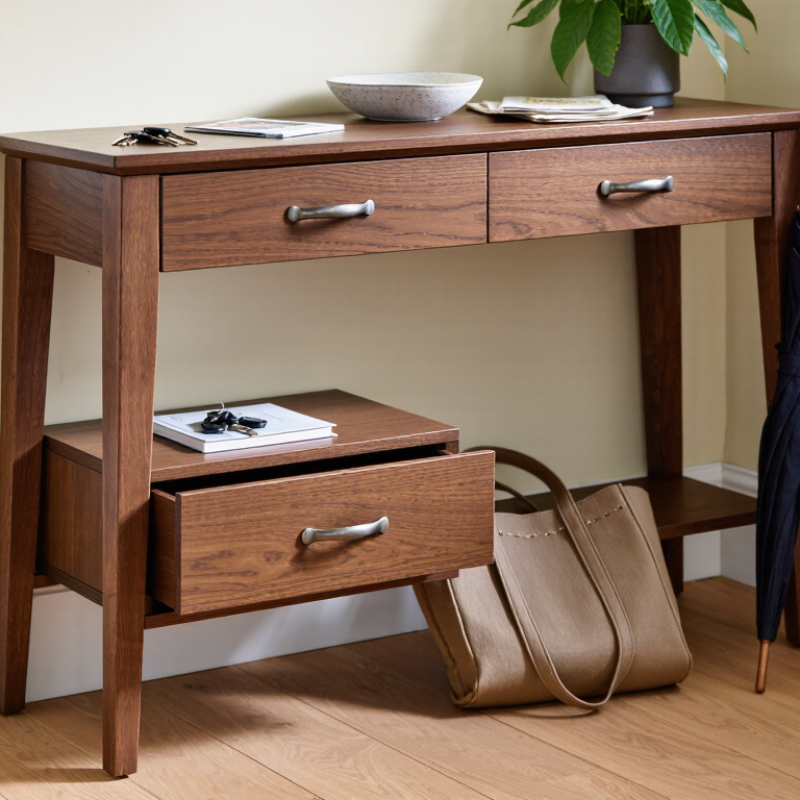
Before comparing finishes or materials, decide what the entryway table must do. Will it hold keys and mail, display a lamp, or provide a place to sit while putting on shoes? A narrow console can keep a small hall usable, while drawers or a lower shelf offer practical storage. Measure the items you plan to place on it, too. A lamp with a broad base needs more depth than a small dish for keys.

Measure the space carefully. Note the wall length, door swing, nearby switches, and the route people take through the entry. Leave enough clearance for doors to open and for bags or coats to pass without catching. In a tight hallway, a table around 25 to 30 centimetres deep may work, but check the actual walking space before ordering. Height matters as well: a surface near hip level is convenient for daily items, though your preferred reach may differ. Measure twice. It sounds obvious, yet an attractive table can still feel awkward when its corners crowd the doorway. For global buyers, confirm dimensions in centimetres or inches and check whether product measurements include handles or trim. A simple paper outline taped to the floor can reveal problems that a screen image hides.

10 Entryway Table Buying Tips for Global Buyers – Define the Entryway Table’s Purpose and Required Dimensions
Tip Buying Consideration Practical Guidance Example Measurement or Check
01 Define the table’s primary purpose Decide whether the table will hold keys and mail, display décor, provide storage, or serve several functions. The intended use determines the suitable top size, height, and storage layout. For everyday essentials, check that the top can accommodate a tray, a small lamp, and frequently used items.
02 Measure the available wall width Measure the usable wall section, allowing for door trim, switches, vents, and nearby furniture. A table should fit the space without obstructing doors or circulation. Record the clear width in centimetres or inches and compare it with the table’s overall width.
03 Check the entryway’s walking clearance Measure the passage after accounting for the table’s depth. Keep enough room for people to pass comfortably, including when the entry door is open. For a main route, a clear passage of about 90 cm (36 in) is a useful planning target where space allows; local accessibility requirements may differ.
04 Choose a suitable table depth In a narrow hall, a shallow console can provide a landing surface while taking up less floor space. Consider protruding handles and decorative objects when estimating the effective depth. Compare the full depth, including any overhang, with the available clearance in the entryway.
05 Match the height to everyday use Select a height that makes it convenient to set down or pick up belongings. Consider the height of nearby seating, wall features, and any items that will sit on the tabletop. Many console tables are approximately 75–90 cm (30–35 in) high, but the best fit depends on the user and the space.
06 Plan storage around the items you own Choose drawers, shelves, or open compartments according to what needs to be stored. Check that drawers can open fully without hitting a door, wall, or nearby furniture. Measure the largest everyday item, such as a mail organiser or storage basket, before selecting a compartment.
07 Account for door swing and other obstacles Map the movement of entry doors, cabinet doors, and drawers. Also note radiators, skirting boards, wall outlets, and uneven flooring that may affect placement. Mark the proposed table footprint on the floor with removable tape, then test doors and walking routes.
08 Consider stability and floor protection Look for a stable frame and suitable feet or levelers, especially on hard or uneven floors. Wall anchoring may be appropriate for tall or narrow furniture, subject to the wall type and installation guidance. Check the product’s assembly and anchoring instructions and use floor protectors compatible with the flooring.
09 Verify delivery access and package dimensions Confirm that the assembled table—or its packages—can pass through entrances, corridors, staircases, and lifts. Flat-packed furniture may simplify delivery but still needs adequate assembly space. Measure the narrowest doorway and compare it with the package dimensions, not just the finished table dimensions.
10 Confirm units, tolerances, and product specifications For international purchases, verify whether dimensions are listed in centimetres or inches and whether they refer to the overall product. Allow for small manufacturing or measurement variations. Record width × depth × height in one consistent unit and confirm the seller’s stated measurement tolerance.

Choose Materials and Construction for Everyday Use

For an entryway table used every day, material choice should match the room, not just the product photo. Solid wood can handle years of keys, bags, and occasional bumps, though it may show scratches or react to humidity. A veneer surface can look refined and stay more affordable, but inspect the edges and underside for secure bonding. Metal frames offer useful stability, while thin legs may wobble on uneven floors. Small details matter.

Check how the table is built. Press gently on a corner and look for movement; loose joints can become annoying quickly. Drawers should slide smoothly when empty and when holding everyday items such as chargers or gloves. If the table stands near a doorway, measure the walkway with the door fully open. A beautiful piece is less useful if a grocery bag catches its edge. Felt pads help protect hard floors, but they will not fix a table that rocks. I once underestimated that difference. Choose a finish you can clean with a soft cloth, and ask which care products are suitable before using polish. For global buyers, confirm the stated dimensions and material description, since terms like “wood finish” can mean different constructions. Inspect the details before ordering.

10 Entryway Table Buying Tips for Global Buyers: Choose Materials and Construction for Everyday Use

These 1–5 ratings are illustrative qualitative comparisons, not standardized test results. Actual performance depends on the specific material, finish, joinery, and design. Check stability, load guidance, edge treatment, and care instructions before buying.

Match the Table’s Style, Storage, and Safety Features

When choosing an entryway table, match its style to the room’s existing shapes and materials. A slim wood table suits warm interiors, while metal or glass can create a lighter, modern look. Measure the wall and walking path carefully. Leave enough clearance for coats, bags, and daily movement. A beautiful table becomes inconvenient when doors or shoes collide with it.

Storage should reflect real household habits, not imagined perfection. Drawers can hide keys, chargers, and mail, while an open shelf keeps baskets within reach. Look for smooth drawer runners and strong joints. These details often reveal better construction. I once chose a table with attractive compartments, but they were too shallow for useful storage. That mistake still matters.

Safety deserves equal attention, especially in homes with children, older adults, or active pets. Choose rounded corners, stable legs, and a clear weight rating. An anti-tip feature is valuable when the table is tall or heavily loaded. Secure it according to the instructions and inspect the hardware after assembly. Check local furniture safety guidance before buying, since requirements can differ between countries. Avoid placing candles, heavy pottery, or unstable objects near the edge. Small details matter. A table may look secure, yet wobble on uneven flooring. Test it gently before daily use.

Verify Quality Standards, Sourcing, and International Shipping

Before ordering an entryway table, ask the supplier for material specifications and inspection records. “Solid wood” can describe different species, grades, and construction methods. Request close-up photos of joints, drawer slides, and the underside. Check whether the finish resists common spills, and confirm the table’s weight capacity. A neat product photo proves little. If quality terms are vague, ask for written measurements and acceptable tolerances.

Tip Request a sample or a pre-shipment inspection when the order size justifies the cost. Compare the delivered piece with the approved sample, including color and hardware. Also clarify how defects are documented and handled. I once overlooked packaging details; the furniture arrived intact, but several cartons were difficult to identify. Small oversights happen.

For international shipping, confirm carton dimensions, gross weight, pallet requirements, and the named delivery point before comparing quotes. Ask who arranges export documents, cargo insurance, and customs clearance, and request an estimate of destination charges. Transit times are estimates, not promises. Check that packaging protects corners and glass, if included, during repeated handling. Keep a dated record of specifications, inspection photos, and shipping updates. This makes disagreements easier to resolve.

Compare Total Costs, Warranties, and After-Sales Support

When comparing entryway tables, calculate the landed cost, not only the quoted price. Include freight, insurance, import duties, taxes, handling fees, assembly tools, and local delivery. A $180 table can exceed $300 after shipping and customs. DHL’s 2024 E-Commerce Trends Report found that delivery options strongly influence online purchases, so confirm the final delivery method before paying. Ask for a written cost breakdown. Hidden charges are expensive surprises.

Warranty terms deserve the same attention. Check coverage for cracked panels, unstable legs, damaged finishes, and missing hardware. Confirm who pays return freight and whether replacement parts are available locally. The warranty period may sound generous, but exclusions can weaken it. The U.S. National Retail Federation and Appriss Retail estimated that 14.5% of retail sales were returned in 2023, representing about $743 billion. Furniture returns can be especially costly because of size and packaging. A clear repair process matters more than impressive wording.

After-sales support should have a reachable email address, response targets, and multilingual instructions. Request photos, installation guides, and spare-part availability before ordering. Keep invoices and delivery images. They help resolve damage claims. I would not assume a long warranty means reliable support. A short warranty with accessible parts may perform better. Still, support policies can change across borders, and this is where many buying comparisons remain incomplete. Check statutory consumer protections in your destination market separately.